Project ZenzaNOT (4/4): What makes a lens swirl
2026-11-01
The state of swirl science on the internet today resembles closely the comments of US Supreme Court Justice Potter Stewart on the topic of obscenity: "I can't define it, but I know it when I see it."
A more precise definition is easy to provide; one that is understandable by those without a PhD in optical engineering is much more challenging.
In this post, I aim to do that: explain in plain, understandable terms 1) what swirl actually is, and 2) what optical properties of a lens contribute to it, by how much.
I have no particular training or education in optical engineering, other than the last year I've spent designing my own lenses using 1930s-era optical formulas.. I have used AI to write programs that handle the optical calculations, and to help me understand the way different variables affect each other, but the writing and explanation here are mine and all this is supported by the three lenses I designed and built. I'm sure some stuff is wrong, and I welcome any corrections.
Constraints
Of course, I (and likely you) are not designing first and foremost for swirl. Unless you are bonkers, swirl comes only after:
-
physical constraints of back clearance (the lens can't hit your mirror) and diameter (can't have an element that would overlap with the mount's flange or that doesn't fit in the camera)
-
focal length - usually you have at least a ballpark idea that constrains the optical system
Some of the levers for swirl discussed below also affect these, and thus aren't fully freely tunable without potentially undesirable side effects.
Swirl
Swirl happens when the out-of-focus light points (bokeh) in an image distort from a circular shape into a shape that is compressed along an axis towards the center but elongated on the perpendicular axis (the axis tangential to the center).
The cumulative effect of every point being smeared tangentially yields the classic impression of circular motion.
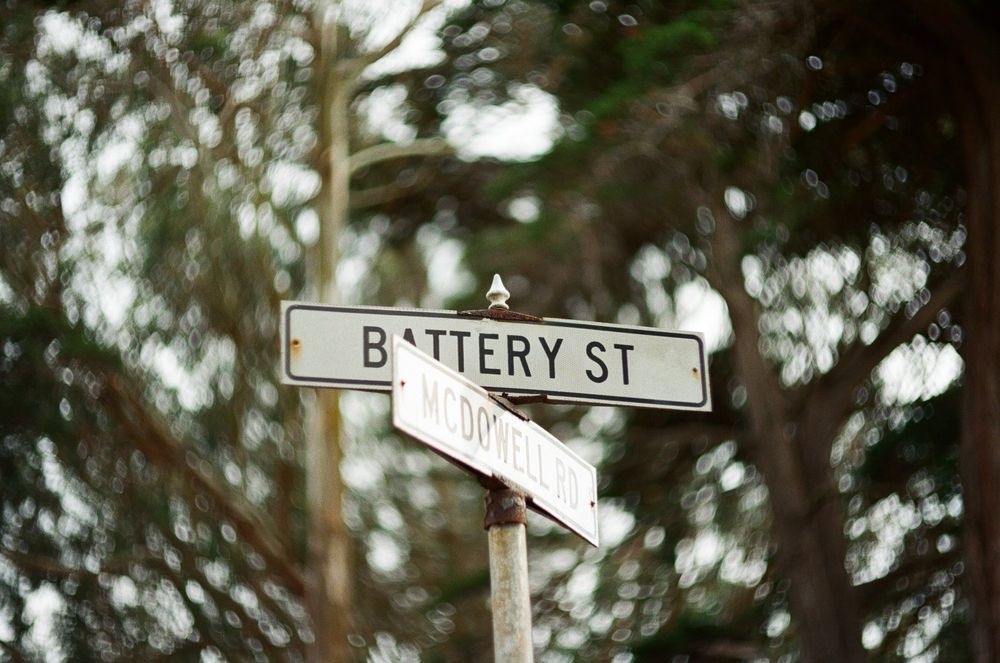
Two optical properties primarily determine swirl: astigmatism, and field curvature. A third, coma, doesn't create swirl but can cancel it. I'll explain all three in more detail below, but in short:
Astigmatism is the difference in how a lens focuses light on two axes, and it controls which direction the blur runs.
Field curvature is the shape of the field of focus.
Field curvature is important for swirl because, for a given composition, it increases the likelihood that the corners and edges will be defocused relative to the subject, allowing the distorted bokeh to appear.
Other considerations matter only to the extent that they influence these factors.
Astigmatism sets the direction
To borrow from Wikipedia, if you took an image of a cross shape through a lens with strong astigmatism, the horizontal and vertical bars of the cross would be in focus at different distances.
Astigmatism is formed when a lens does not balance the focus point for light coming in at different angles. Lines running radially from the center focus at a different distance than do lines running around it (tangential lines).
(Textbooks call the radial one "sagittal." I'm going to try not to use that word. Like a chimp with a stick, I understand it well enough to use it, but not well enough to teach the tribe.)
This difference transforms off-center points from round blurs into directional, oriented streaks or smears. The smear grows with distance off-axis, which puts the strongest ones in the corners.
The direction a point smears depends on whether radial or tangential line focuses closer to the film plane.
If the film is closer to the depth that sharpens the tangential lines (the ones running around the center), the corners smear into arcs around the center: classic swirl. But if the film is closer to the depth that sharpens the radial spokes, they smear radially away from the center (I call this "tie-dye" because the bokeh seem to rush centrifugally outwards). Balanced between the two, the blur stays round.
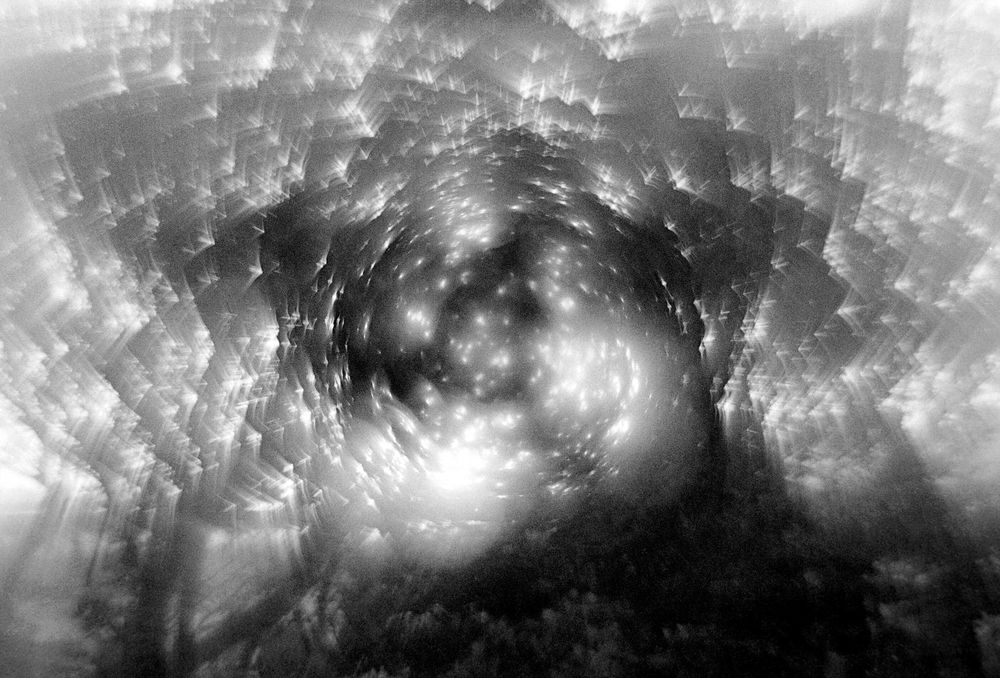
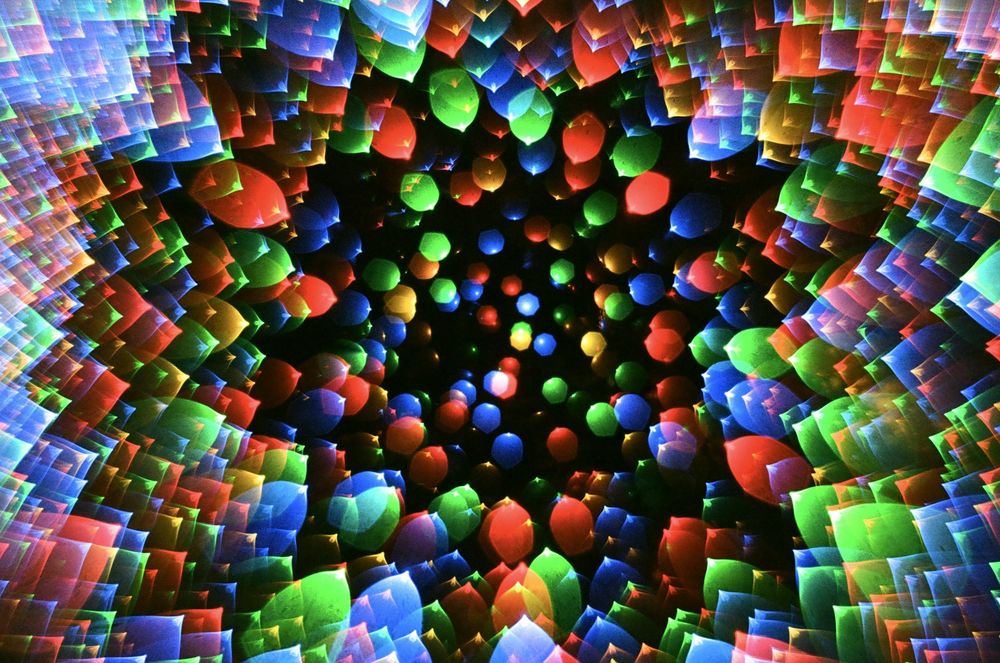
Thus the type of blur flips between the out-of-focus foreground, and the out-of-focus background (assuming you are focused to a mid length). But, to be clear, here I'm discussing swirl as a background effect, even though the same lens may tie-dye when the bokeh generating points of light are between the lens and the focus plane.
Astigmatism is a tug-of-war between the elements, with three factors primarily determining the outcome:
-
An element's power sets its pull and the direction of that pull. Left to itself, a positive element pulls the background smear radial (tie-dye), and a negative element pulls it tangential (swirl). The stronger the element, the harder it pulls. This is why a lone positive lens, like a magnifying glass or a box camera lens, tie-dyes a distant background instead of swirling it, and why I've come to believe a swirly lens needs a negative element doing real work somewhere.
-
The shape of an element can change its pull without changing its power, so two elements with the same focal length can still have opposite pulls. Shape and stop placement can even override the default: the classic Petzval portrait lens is nearly all positive power, yet its rear group is bent and placed so the tangential focus gets pushed outward, which is what makes it swirl.
-
Where the light crosses each element matters as much as the element itself. Light from the edge of the frame hits each element off-center, and the further off-center it hits, the more that element splits the focus (it goes as the square of the distance). Wider spacing is the easy way to push that light further off-center on the next element. Stop position and element order do it too, and I'll get to those below.
Field curvature gets the corners out of focus
Unless it's engineered otherwise, a lens does not come with a flat field of focus. Left to simple physics, a lens focuses the world onto a shallow bowl instead of a plane. Designers flatten that bowl on purpose, with extra elements and careful glass, and a good modern lens has flattened it almost completely. Simpler and older designs never did, and a few early cameras gave up and just curved the film itself to sit in the shape of the bowl.
The depth of that bowl is the Petzval sum. The Petzval sum has one term for each element (roughly 1 / (glass index * focal length)), and its total predicts how steeply the field curves. More on glass index in a moment.
Strong positive elements and weak negatives drive it up: a deeper bowl, and a stronger pull toward swirl. A steep bowl drops the corners out of focus more aggressively, leaving plenty of soft blur for astigmatism to work on.
Note: the thin depth-of-field from a wide or wide open aperture accentuates the effect of field curvature, since the thinner DOF applies across the whole field.
Controlling field curvature
Bowl shape
Beyond just its depth, optical design can affect how steeply the walls of the bowl curve at different distances from its center.
Its curvature can concentrate mostly out at the edges while the center stays nearly flat, or it can bend the whole field evenly from the middle outward. Push the curvature around moves where the field holds focus and where it falls away, and that in turn, sets where in the frame the corners start to blur.
Unless you are solely interested in the abstract, a flat center is important for having a reasonably sharp subject in focus.
What flattens the center in a simple lens is astigmatism working against the bowl: the tangential focus bends back out toward the film while the radial focus follows the bowl inward. That's the same arrangement that swirls the background (see astigmatism above), so the direction that swirls is also the direction that widens the flat center. You don't have to trade one for the other. The old Petzval portrait lens did this on purpose; Kingslake says its designers used astigmatism to flatten the tangential field.
Two cautions. A flat center is not the same as a sharp one: spherical aberration can make a lens soft on axis no matter how flat its field is. And getting the direction right doesn't make the swirl strong (a Tessar has the same sign of astigmatism at the edge and barely swirls, because its bowl is shallow). The real tradeoff is depth of bowl against width of flat center. Deeper swirls harder, but the flat zone shrinks.
Element Powers
The division of negative power across elements affects the bowl's shape.
While the Petzval sum counts only the total depth, but this doesn't account for the shape fully. One strong negative and several weak ones that add up to the strong one may have the same depth, but those configurations do not curl the same way at the edge.
A single strong negative probably bends the edge rays harder than the same power spread across gentle elements, so the field falls off faster near the corner than the smooth bowl the Petzval sum predicts. I think this is why conventional designers split strong elements, along with the spherical aberration and coma that come with them.
I expected to exploit that by keeping the power concentrated. It did not work. My math can't model the edge curl, so I can't confirm the effect, and v13f (built around a single strong negative) tie-dyed instead of swirling because of the coma (see below). The lenses that swirled used a gentler negative in a cemented doublet.
There's a reason to want a gentle shape anyway. Negative power subtracts from the Petzval sum, so a stronger negative makes the bowl shallower, not deeper. Once the negative is strong enough to set the swirl direction, anything beyond that costs you swirl (at least in my math; I haven't tested where the line is).
Glass type
Glass is the other lever on the depth of the bowl (as it appears in the per-element petzval terms of 1 / (glass index * focal length)). For a given focal length, low-index glass curves the field harder and high-index glass flattens it.
Optical engineers (who want a conventional lens) can pair a high-index positive element with a low-index negative one and their Petzval terms cancel, pulling the field flat. While early lens designers didn't have high-refraction glass capable of this, anastigmats with this kind of glass have become the conventional solution to field curvature.
For our purposes, the goal and mechanisms are the opposite: To get the deepest bowl, we want low-index positives and high-index negatives to push the Petzval sum up, instead of cancelling it.
I never got to use this lever. Everything SurplusShed sells cheaply is ordinary crown glass at about the same index, and the achromats come as they are. So this is theoretical, not something I tested, but I think it's pretty well-understood.
Image circle and format
Astigmatism and field curvature both build toward the edge of the field and leave the middle calm. So whether you see any swirl from a given lens depends on how much of that field your film sees.
A lens projects a circle of image, and your film is a rectangle cut from the middle of it, the way a proscenium frames the play and blocks the backstage. If the rectangle only barely fills the circle, its corners sit out in the rough part of the field where the smearing lives. But if you use a lens whose circle dwarfs your frame (one built for a bigger format than you're shooting), your frame sees only the quiet center.
When designing to promote swirl, you want image circle tight to the format for this reason. If the image circle is too small, the circle starts to become visible in the corners as vignette (see below).
Absent a retrofocal design, shortening focal length shrinks the image circle, thus pushing the frame towards the outer swirl zone of the image circle.
Aperture position
Sliding the aperture forward or back moves the astigmatism, which strengthens the smear, weakens it, or flips its direction.
On paper this is a clean lever: the focal length, back focus, and depth of the bowl are unaffected; only the astigmatism (and coma) change.
In practice, aperture position is only secondarily useful. If you want fancy bokeh, relying on fancy aperture placement means you're not shooting wide-open, which translates to much smaller bokeh artefacts. I put the stop slot as close to the optimal place as the housing allowed (the optimal place was often underneath the ring that grips the S2's bayonet lugs where it would be impossible to change stop discs, so the slot had to go either ahead of, or behind the mount-zone), and hoped for the best.
However, even when wide open, some part of the lens design (usually an element) is the most constricted optically. This element effectively becomes the aperture (and the basis for the calculation of f-number (focal length / entrance pupil diameter)). But now your "effective" stop placement is tied to the position of that lens, which is complicated and yucky if you're also trying to use the stop for bokeh. Moreover, with aperture governed by the diameter of that element, increasing it means finding new glass, and decreasing it just sacrifices speed.
One more thing I didn't expect: on the lens with the three zones described below, stopping down to f4 pulled the flip inward, so more of the frame went to tie-dye, not less. That's one roll from one lens, but it's the opposite of what I assumed.
Element order and field curvature
Reordering the elements does not change the field curvature. The Petzval sum comes out the same regardless of term order, so three given elements bend the field into the same bowl whether the negative one sits first, middle, or last.
Astigmatism is another matter. The same elements in a different order hand the off-axis light different crossing heights, so the smear can strengthen, weaken, or flip direction while the bowl stays put.
Order also influences the back focal distance, or how far behind the last element the image forms (important for an SLR, whose lens has to clear a swinging mirror). A creative ordering can meet those physical requirements, maintain the field shape, and potentially even increase astigmatism.
Coma
Coma flares an off-axis point into a little comet: a bright head with a tail streaming out along the spoke, toward or away from the center. Like everything else here, it's nothing in the middle, worst in the corners, and it grows as aperture opens up.
The tail runs radially, the same axis as tie-dye and crosswise to classic swirl. Mostly you see it as a one-sided teardrop on the edge highlights, the lopsided bokeh of old fast lenses.
Coma competes with astigmatism for the direction of the blur. Astigmatism of the right sign pulls the corners tangential; coma always pulls them radial; whichever is stronger wins. So a lens can have textbook swirl astigmatism and still tie-dye on film.
I think this is why my v13f lens exhibited such strong tie-dye. My calculations of the astigmatism indicated swirl, but the negative element driving astigmatism was a single piece of glass, and a strong negative singlet is also a big source of coma in a simple lens. The coma (which I wasn't measuring at the time) overpowered the astigmatism, yielding tie-dye.
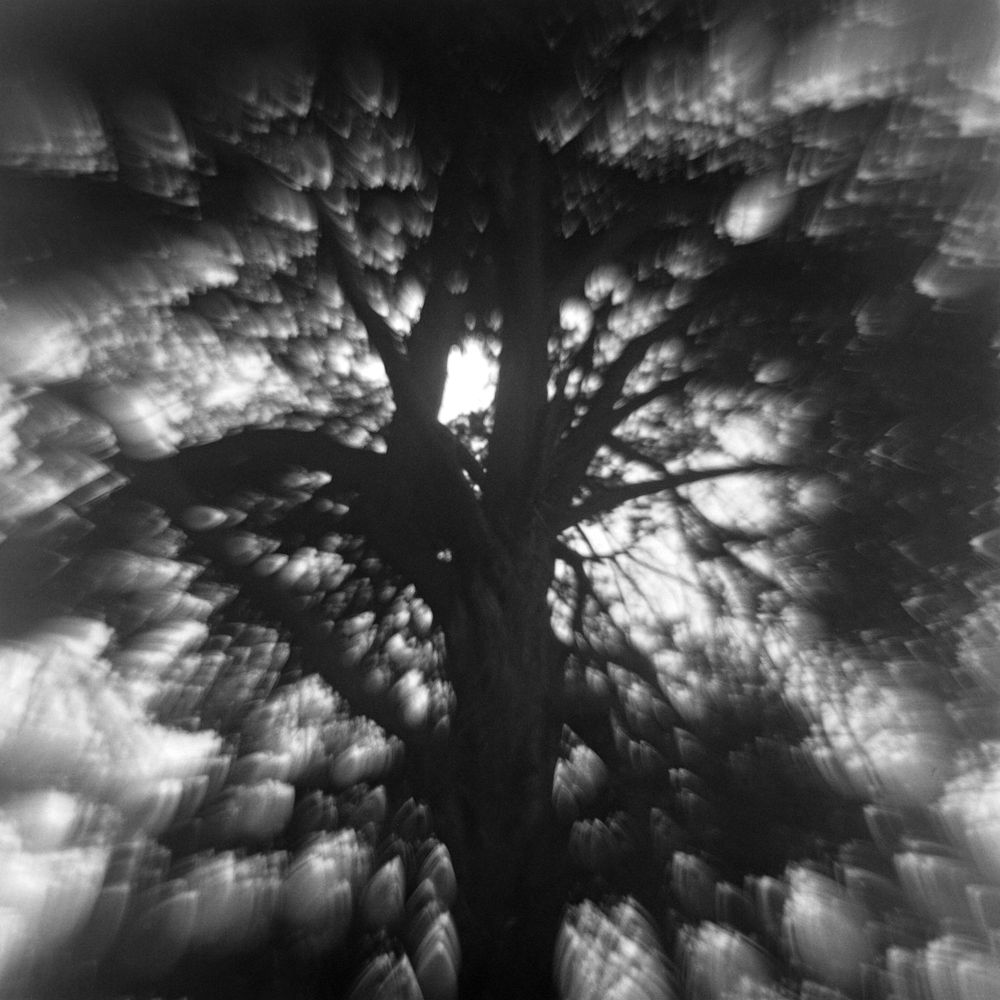
The fix is to use a cemented doublet (an achromat) for the negative element instead of a single piece of glass, which has the same negative power but much less coma. My next two lenses took this approach. Both swirl where the earlier one tie-dyed, so I think this is right (though it may be more complicated than just this).
The cheap way to swirl happens to also be the cheap way to coma. Concentrating the power onto one or two strong elements produces the steep edge curl that swirls, and the coma comes along with it. The conventional fix, splitting those strong elements into gentler ones, softens the edge curl as well. So it's roughly a pick-two-of-three: a simple lens, one that swirls, and one with little coma. The cemented negative doublet is the one cheat I found that gets you most of all three.
Unexpected additional bokeh regimes
My programs treat the frame as only two zones (a center area and periphery), but the test photos showed three distinct regions with different regimes (the sharp center, a swirl ring around the center, and tie-dye the periphery).

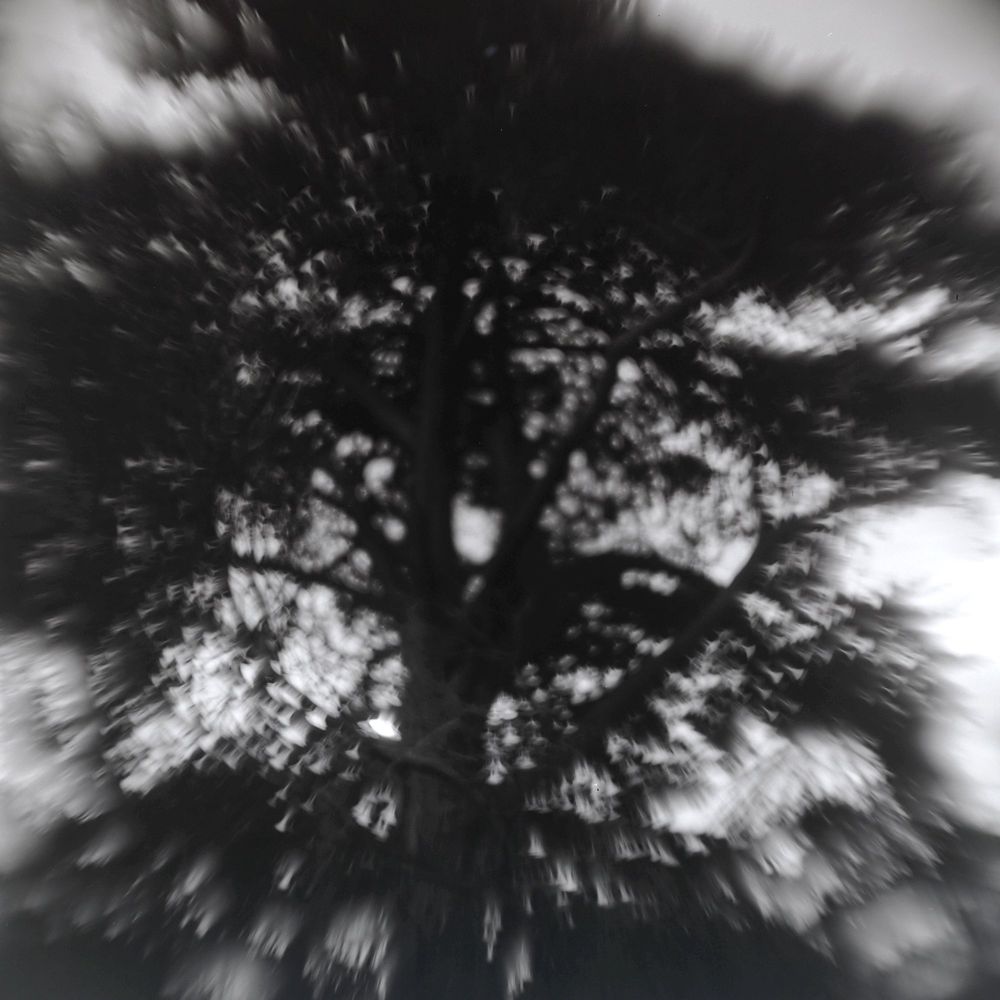
I don't think I can predict the flip in bokeh between the ring and periphery with 1930s math - it's coming from something higher-order. I'm pretty sure that a longer focal length pushes it outwards (but flattening the bowl), and I think that a stronger astigmatism also pushes it outwards (but by how much I can't model).
Focus distance
The ring of swirl only showed up when I focused close. Focused on a subject at a normal distance, the same lens at the same aperture read radial from the middle of the frame outward, with no ring at all. I have no model for this, so I'll just note that focus distance changes which regime you get - this is something to explore more in the future.
Postscript: cat eye vignetting
Vignetting is a third cause of swirl, and the only one that is purely mechanical. It is the same corner darkening you already know from a fast lens shot wide open.
Vignetting affects swirl because, wide open, the off-axis light cone has to clear every opening in the lens in turn: the front rim, the stop, the rear rim, the barrel. Toward the corners it no longer fits, and the rims cut into it. The front rim clips one edge of the corner cone and the rear rim clips the other. The two sit at different depths, so their clips land offset, and the sliver left between them is the cat eye. Every cat eye orients the same way around the frame - tangentially.
A field of cat eyes creates a very similar swirl impression as the optics discussed above, but via a different mechanism. (Interestingly, cat eye bokeh does not flip between swirl and tie-dye across the focus.)
(Stopping down, the stop becomes the single tightest opening from every angle, the rims do not clip, and the corner highlights round out.)
For this project, analyzing or taking advantage of this lever has been out of scope - it basically requires ray tracing and more detailed measurements of the elements than I'm capable of.
I did succussfully predict the vignette on the last lens, confirmed with the photos.